Impulse Space and Relativity Federal are being assessed for capability and tailored mission assurance; the bench is now seven providers deep.
02 Lane 1 is the on-ramp; Lane 2 is the high-mission-assurance track.Lane 2’s $13.68 billion three-provider award sets a different clock through 2032. Lane 1 is where a new provider proves its next launch.
03 SDA Tranche 2 Transport Layer Beta is a 72-satellite production signal.Northrop Grumman and Lockheed Martin hold the awards; the relevant read is which sub-tier commitments are already fixed.
04 Allan Aircraft Supply is named only at pipe, tube, weld, and specialty-fitting interfaces.The North Hollywood supplier’s published scope is not a claim to a dome, engine, heat pipe, or radiation-hardened-electronics role.
05 The small number is the qualification signal, not the endpoint.A prior $734 million Lane 1 task order to SpaceX is the reminder that the assessment task can be the entry point to a larger mission line.
Notes from the co-founders
On 8 July 2026, Space Systems Command added Impulse Space and Relativity Federal Inc. to NSSL Phase 3 Lane 1 and issued each a $5 million firm-fixed-price task order. The announcement is easy to misread because the dollar figure is deliberately small. We are reading the task orders as what they say they are: a capabilities assessment and an approach to tailored mission assurance, purchased before a provider is trusted with a larger launch assignment. The paper is reading the on-ramp as a federal procurement instrument designed to find out which new launch providers can qualify on a shorter clock, not as a minor award that can be dismissed beside Lane 2’s billions. SSC’s announcement calls Lane 1 the route for rapid contract award, streamlined integration, and reduced timelines for more risk-tolerant missions. That language is the operating instruction.
Seven providers now sit on the Lane 1 bench: Blue Origin, SpaceX, and ULA from FY24; Rocket Lab and Stoke Space from FY25; then Impulse Space and Relativity Federal in FY26. We are reading that bench against the three-provider Lane 2 award, not confusing the two. The paper is also reading what the on-ramp does below the prime: a California shop that can document a qualified tube, pipe, weld, or specialty-fitting interface has a different opening when a provider is building its supply chain and proving tailored mission assurance than when a mature prime is executing a high-mission-assurance program. That does not lower the quality bar; it changes the timing of the qualification conversation.
Who this matters to: the California AS9100 supplier whose work can be proved, traced, and delivered before a Lane 1 provider has finished hardening its roster. The question is not whether a small task order is large enough to celebrate. The question is whether the capability card in front of us lets us place that supplier on the list a new provider reads before the next task order is assigned. Theresa Padilla-Chaparro and Diego F. Padilla are reading those cards against the public record, one process at a time. Through the next six issues, the paper will be looking for the first Lane 1 launch result, the second task-order pricing, and the point at which seven providers become a smaller group of survivors. That is the moment when early qualification will matter most.
One capability card, from every member company, to Diego F. Padilla at diego@rakarinc.com, before the next monthly AMA. One page: certifications held with expiry dates, processes performed in-house, maximum part envelope, current lead time, and one named federal agency or prime contractor for which you are already an approved supplier. No brochure, no capabilities deck, no company history.
Cards received before the monthly AMA are reviewed on that call; cards arriving after it are worked in the cycle that follows. They are read against the public record in Standing Watch, and where a relevant and consenting contact exists the cluster offers a named introduction. Cards not received are not matched. That is the entire mechanism.
Oxnard, California · Saturday, 8 August 2026.
The seventh chair
Two additional $5 million task orders under NSSL Phase 3 Lane 1 are small only if the reader treats the on-ramp as an endpoint. Space Systems Command is using them to assess capability and tailored mission assurance before the next provider competes for a launch; that is why a seven-provider Lane 1 bench matters to the California sub-tier.
ONE On 8 July 2026, SSC awarded Impulse Space and Relativity Federal Inc. a firm-fixed-price, indefinite-delivery/indefinite-quantity Lane 1 contract and a $5 million task order each.
TWO The immediate work is an initial capabilities assessment and a tailored-mission-assurance approach, not a priced launch manifest. The task order is a test of qualification.
THREE Lane 1 now has seven providers. That is a competitive pipeline, not an oligopoly, and it differs sharply from Lane 2’s three-provider concentration.
FOUR A supplier is not promised work by this on-ramp. But a provider building its roster on a compressed timetable has reason to evaluate a credible second source earlier.
FIVE The $5 million assessment should not be romanticized. The prior Lane 1 record includes a roughly $734 million SpaceX task order for seven Falcon 9 launches supporting SDA Tranche 2 Transport Layer.
SIX The unresolved read is which provider fails first, who prices the second task order below the $734 million benchmark, and whether the seven-provider bench then compresses before its sub-tier has qualified.
The seventh chair
A procurement story from Space Systems Command, 8 July 2026 — and what a seven-provider Lane 1 bench changes for California’s supplier base.
One — what the government bought
On 8 July 2026, Space Systems Command announced two additional NSSL Phase 3 Lane 1 contracts: one to Impulse Space and one to Relativity Federal Inc., a subsidiary of Relativity Space. Each is a firm-fixed-price, indefinite-delivery/indefinite-quantity contract with a $5 million task order at award. SSC states that the work is to conduct an initial capabilities assessment and develop an approach to tailored mission assurance. The phrase matters. The government did not buy a launch on this task order. It bought evidence about whether each provider can become the kind of launch counterparty that can carry a future mission.
That is the first discipline of this issue: read the instrument that was actually awarded. The $5 million is neither a launch price nor a promise of a follow-on. It is a paid qualification step. SSC’s acting Portfolio Acquisition Executive for Space Access, Col. Eric Zarybnisky, described Lane 1 as the route for rapid contract award, streamlined integration phases, and reduced timelines from award to launch for more risk-tolerant missions. The on-ramp is therefore a market-making mechanism. It puts a provider’s capability, documentation, and proposed mission-assurance posture under a federal read before the provider receives the larger assignment.
Two — the two lanes are not interchangeable
The temptation is to place every NSSL number in one pile. That produces the wrong reading. Lane 1 is the on-ramp and risk-tolerant track. Lane 2 is the high-mission-assurance track. As summarized in the Congressional Research Service NSSL primer, the April 2025 Lane 2 awards went to Blue Origin, SpaceX, and ULA: $2.4 billion, $5.9 billion, and $5.4 billion respectively, or $13.68 billion across approximately 54 missions from 2027 through 2032. Those are not small awards and they are not a substitute for the Lane 1 question.
Lane 1 now holds seven providers: Blue Origin, SpaceX, and ULA on-ramped in FY24; Rocket Lab and Stoke Space in FY25; Impulse Space and Relativity Federal in FY26. The relevant contrast is not that seven is larger than three. It is that seven is a provider bench formed before the market has settled on the few firms that will execute the next set of missions. Lane 2 rewards an already-qualified concentration. Lane 1 is rewarding a wider pipeline of capability claims that still have to survive mission assurance and launch execution.
Three — seven is a pipeline, not an oligopoly
Seven Lane 1 providers should not be read as seven equivalent launch businesses or seven guaranteed procurement streams. It should be read as the government preserving competition at the point where a provider can still be tested. That is a substantive shift from a three-provider Lane 2 concentration. It also alters the supplier conversation. A launch prime competing with six peers for a more risk-tolerant NSSL assignment has an incentive to prove that it can qualify, document, and integrate quickly. A credible new second source in its own supply chain can be useful to that proof when the provider is still assembling the combination of process, schedule, and mission-assurance evidence it will present.
This is not an argument that a supplier’s standard becomes optional. It is the reverse. A provider running a compressed qualification schedule needs a supplier whose records can be read without reconstruction: traceability, a declared scope, certified quality management, and a clear account of what the shop does and does not make. The useful supplier is not the one promising every category. It is the one whose narrow capability can enter a mission-assurance package without being translated into a broader claim.
Four — the sub-tier read in California
For a California AS9100 shop making tube-and-pipe fittings, weld ends, or valve-fitting interfaces, the Lane 1 reading is immediate. Allan Aircraft Supply Company states that it manufactures and distributes tube, pipe, weld, and specialty fittings for aerospace and industrial industries. Its published product line includes Mil-Spec 37-degree flared tube and pipe fittings, stainless steel and other alloys, AN and MS boss and ring seal fittings, weld ends, and DFARS-compliant materials. That is a defined interface category, not an assertion that Allan Aircraft Supply is a dome, hypergolic-engine, heat-pipe, or radiation-hardened-electronics supplier.
A provider entering Lane 1 is building a smaller, more opinionated supply chain while it is demonstrating how it will run tailored mission assurance. Being on the roster a prime hands to Impulse Space or Relativity Federal in the next twelve months is not the same qualification game as being on the roster handed to SpaceX or ULA. It can be a shorter conversation with fewer gatekeepers, but it remains a conversation won by proof. The qualification bar should be read against a $5 million capabilities-assessment task order, not treated as if it were a $700 million block buy. The supplier that is ready with its records before the roster is fixed has a different chance from the supplier that waits for a public launch award.
Five — why the small number is the wrong dismissal
The trades will see two $5 million task orders beside Lane 2’s billions and call the Lane 1 awards marginal. That is the wrong reading. Lane 1 is the pipeline. The small task order purchases the conditions for a provider to receive a later, consequential task order. The public record already includes a prior Lane 1 task order in which SpaceX received approximately $734 million for seven Falcon 9 launches supporting the SDA Tranche 2 Transport Layer. Air & Space Forces’ reporting on the 72-satellite Tranche 2 context makes clear why a launch cadence and its production commitments matter to the broader base.
No one should infer a direct line from the $5 million assessments to a $734 million award. The programs, provider positions, and missions are not interchangeable. The point is diagnostic: a modest first task order can be the qualification event that determines who is even eligible to compete for the later work. The supplier who dismisses the first number may arrive after the provider’s mission-assurance package and approved roster have already hardened.
Six — the test the paper will keep applying
The paper will read the next six issues against two unresolved questions. Which of the seven Lane 1 providers will fail its first Lane 1 launch? Which will price a second Lane 1 task order under the roughly $734 million SpaceX benchmark? Those questions are deliberately uncomfortable because a provider bench does not remain seven providers forever. When execution risk and price competition appear in the same quarter, the bench may compress to three or four survivors. That is when the early sub-tier qualification becomes visible as an advantage rather than a capability statement.
The working instruction is not to chase every provider with a generic deck. It is to identify the supplier interface the provider can actually use, demonstrate the quality record the provider can carry into tailored mission assurance, and establish the relationship before a second task order forces a narrower choice. The seventh chair is not a ceremonial seat. It is an open place in a procurement pipeline, and it will not stay open by itself.
FIELD SIGNAL / MISSION ASSURANCE“A compressed schedule does not remove the paperwork. It exposes whether the supplier can place a narrow, traceable capability into a mission-assurance package without asking the prime to explain it for them.”
— FIELD DESK NOTE FOR THE SPACE OBSERVER · WEEK OF 8 AUGUST 2026
Teaming Desk
The Teaming Desk is not a directory. Theresa Padilla-Chaparro and Diego F. Padilla read capability cards against a live instrument’s named interface, certification, and delivery logic. This week the Desk names Allan Aircraft Supply only against pipe, tube, valve-fitting, and weld-end interfaces.
Needed — a California AS9100 tube-and-fitting supplier that can qualify on the compressed timelines a Lane 1 provider is running against a $5 million capabilities-assessment task order.
Needed — documented tube, pipe, weld, and specialty-fitting interfaces. The Desk is reading narrow, traceable supply capability rather than a general claim to launch hardware.
·Offered — Allan Aircraft Supply, North Hollywood. Allan Aircraft Supply states that it manufactures and distributes Mil-Spec 37-degree flared tube and pipe fittings, AN and MS boss and ring seal fittings, weld ends, and fittings in stainless steel and other alloys.
·Offered — capability matching. Send a one-page capability card to diego@rakarinc.com. The record is read against Standing Watch, then matched only where the process, certification, and timing fit.
Allan Aircraft Supply Company, LLC
Allan Aircraft Supply Company, LLC is the Issue 009 featured member and entry #10 of the SpaceReturn///// California Space Cluster roster. Founded in 1952, Allan Aircraft Supply operates in North Hollywood, California and is named here only for its published tube, pipe, weld, and specialty-fitting capability.
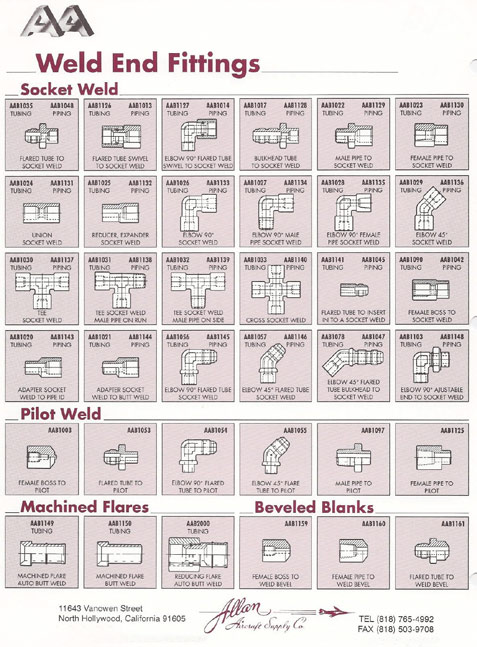
Allan Aircraft Supply states that it was founded in 1952 and manufactures and distributes tube, pipe, weld, and specialty fittings for aerospace and industrial industries. Its published product line includes Mil-Spec 37-degree flared tube and pipe fittings, stainless steel and other alloys, AN and MS boss and ring seal fittings, weld ends, and DFARS-compliant materials. Allan Aircraft Supply lists 11643 Vanowen Street, North Hollywood, California 91605, with a multi-building single-site quality-management system across 11629, 11631, 11639, 11643, and 10835 Vanowen Street.
PRI Registrar certificate 21254 records Allan Aircraft Supply’s AS9100D single-site quality-management system, issued 5 December 2024 and expiring 4 December 2027, with the scope: “Manufacture and Distribution of Tube, Pipe, Weld and Specialty Fittings for Aerospace and Industrial Industries.” Allan Aircraft Supply also identifies ISO 9001:2015 and NADCAP registration. The company’s CAGE code is 06581 and its NAICS classification is 3364, Aerospace Product and Parts Manufacturing.
Allan Aircraft Supply has a bounded capability that reads directly to the pipe, tube, valve-fitting, and weld-end interfaces a launch provider may need to document. Allan Aircraft Supply is not being presented as a dome manufacturer, a hypergolic-engine supplier, a heat-pipe assembly house, or a radiation-hardened-electronics provider. Allan Aircraft Supply’s published leadership record identifies Kris Kahmann as President, with Dylan Farnam as VP Operations, Jose Perez as Quality Assurance Manager, Brian Heurkins as Production and Procurement Manager, and Deron Rackie as Warehouse Manager. The company’s published customer list includes Virgin Galactic, Boeing, Lockheed Martin, Pratt & Whitney, General Electric, NASA, Northrop Grumman, Raytheon, Honeywell, United Technologies, Hawker Beechcraft, Bath Iron Works, Ingalls Operations, FMC Corporation, Vought, United Space Alliance, United Launch Alliance, MD Helicopters, and Cessna.
This profile prints Allan Aircraft Supply’s published capability record and its verified cluster-roster status as entry #10. Corrections and additions from Allan Aircraft Supply are welcome and will be printed in the following issue.
The pipeline is priced before it is visible
Capital Flows is reading the difference between an assessment award and a launch backlog. The visible numbers are not substitutes for one another; together they describe the two ends of NSSL’s provider pipeline.
Bars show the published absolute figures. Assessment task orders are not launch awards.
The small end of the instrument
Impulse Space and Relativity Federal each begin with a $5 million Lane 1 task order for capability assessment and tailored mission assurance. The dollar amount is deliberately not being compared as a price per launch. It is the price of an evaluation step. The relevant capital read is that two additional providers have been admitted to a federal pathway where a future assignment can depend on the documentation and integration approach they establish now.
The concentrated end
Lane 2 supplies the opposing scale: $13.68 billion across approximately 54 missions, awarded to three providers for 2027 through 2032. FY26 assignments place five missions and $714 million with SpaceX, and two missions and $428 million with ULA. Those figures describe a high-mission-assurance backlog with a different risk posture and a smaller provider group. They should not be read as a reason to dismiss the Lane 1 bench; they explain why the bench matters.
The reference price
The public record contains a prior Lane 1 SpaceX task order of approximately $734 million for seven Falcon 9 launches supporting SDA Tranche 2 Transport Layer. Alongside it, the T2TL Beta awards are $733 million to Northrop Grumman and $816 million to Lockheed Martin for 72 satellites total. These are not interchangeable procurements. They show that the assessment, the launch assignment, and the satellite-production commitment are separate capital events in one industrial system.
What the paper will not turn into a ratio
Issue 008 carried the prior Voyager acquisition of Astrobotic at approximately $300 million enterprise value as rolling context. This issue does not treat that transaction as a comparable NSSL metric. The operating comparison here is narrower: a $5 million initial assessment can be a qualification gate, while $13.68 billion in Lane 2 and the prior $734 million Lane 1 task order reveal the scale available after a provider is trusted with execution.
Ventura County — the county office the paper is reading, and the person in it
Ventura County Watch is the paper’s standing read of the local industrial base the cluster sits inside. This second issue keeps the county-side counterparty in view while the federal Lane 1 on-ramp sets a new qualification clock.
Estelle Bussa, Deputy Executive Officer for Economic Vitality
Estelle Bussa remains the county-side counterparty in this desk. The paper is reading her office’s economic-vitality posture alongside the supplier record that a California launch and aerospace sub-tier needs to put forward. The fresh local signal is the Area 805 Advanced Air Mobility test range at Camarillo and its FAA-approval read-out: the relevant question is not whether advanced air mobility is identical to space, but whether the region is building the flight-test, certification, and industrial coordination habits that also matter to a space supplier.
Why Ventura County reads to space, specifically
Ventura County reads to space through the Point Mugu Sea Range and its interlock with Vandenberg’s Western Range; Naval Surface Warfare Center Port Hueneme; Fathomwerx and FutureLabs; Area 805; and a dense AS9100 sub-tier. These are not claims that every county aerospace program is a space program. They are the physical and institutional reasons a supplier in the county is already inside a Southern California flight, test, and procurement geography. The paper will continue to read whether that geography produces documented qualifications rather than broad regional rhetoric.
The tract question remains open
The desk did not verify a specific Camarillo, Simi Valley, or Oxnard tract change on the HUBZone map this quarter from the source record used for this issue. It therefore names no tract. The reading window remains open: a verified change will be printed only when the map and its local consequence can be identified together.
Two capitals, one supply chain
The paired desk reads the state and federal policy surfaces a California sub-tier sits inside, together, because a supplier’s location and its mission-assurance documentation are part of the same qualification conversation.
Sacramento · the state-side reading
SpaceX in Hawthorne, Rocket Lab in Long Beach, and Relativity Space in Long Beach are the California-based names that matter to the Lane 1 and launch-provider landscape. This desk did not verify a current-quarter CalCompetes or STEP grant specific to one of those providers from the source record used for this issue. It will not promote a generic state-support claim in place of a verified award. The reading window is the current quarter: the desk is looking for a named California instrument, recipient, award date, and amount before it draws a policy conclusion.
Washington · the federal-side reading
DFARS 252.225-7002 remains part of the qualifying-country subcontracting rule set. The Lane 1 requirement adds a more immediate operational question: how does a supplier’s documentation package enter a provider’s tailored-mission-assurance approach? For a California tube-and-fitting shop, the answer begins with a bounded scope, material and quality records, certifications, and a clear statement of the interface supplied. The clause and the tailored-assurance work do not create the same requirement; together they make disciplined documentation more useful on a compressed provider schedule.
Cluster assessment, unverified. The desk is not asserting a current California grant for a named Lane 1 provider. It is preserving the question until a state record supports it, while reading the federal on-ramp against the documentation a supplier can produce now.
Tuesday, 1 September 2026
11:00 AM Pacific · 45 minutes · in person & virtual
Ask Me Anything. Direct engagement with the cluster co-founders on programs, teaming, and the California space supply chain. Open to entrepreneurs, engineers, researchers, and anyone working in or near the space economy.
1680 Universe Cir
Oxnard, California 93033
Cadence · first Tuesday of every month · 11:00 AM Pacific · recurring. Capability cards submitted by 5:00 PM Pacific the day of the call are worked in the cycle that follows. By-Laws & Capability Statement at spacereturn.org.
Build the cluster with us.
SpaceReturn///// the California Space Cluster is a membership body of California space and aerospace manufacturers, operators, test facilities and service providers. Membership enquiries: diego@rakarinc.com.
NSSL and production record
- Space Access awards two contracts to on-ramp NSSL providers, 8 July 2026 — Space Systems Command
- National Security Space Launch (NSSL) Defense Primer — Congressional Research Service
- SDA Tranche 2 72-satellite context — Air & Space Forces
Member profile — Allan Aircraft Supply
- Allan Aircraft Supply Company — allanaircraft.com
- Allan Aircraft Supply Company, leadership and company profile — Allan Aircraft Supply About page
- AS9100D certificate 21254, issued 5 December 2024, expires 4 December 2027 — PRI Registrar certificate PDF
- Allan Aircraft Supply awardee record — HigherGov
- Kris Kahmann public professional profile — LinkedIn
Method & colophon
Figures are drawn from the linked public record. Conclusions the record does not itself state are hedged or marked as cluster assessment. The paper distinguishes the Lane 1 on-ramp from Lane 2 rather than flattening the two into one launch-market claim.
- Published by
- SpaceReturn///// The California Space Cluster
- Co-publishers
- Theresa Padilla-Chaparro · Diego F. Padilla
- Compiled from
- Primary records and identified reporting, linked alongside
- Member contributions
- Allan Aircraft Supply Company capability record
- Corrections
- info@spacereturn.org
- Dateline
- Saturday 8 August 2026 · Oxnard, California
Use this briefing.
Forward it to one supplier who is not yet a member.
Member capability card. Standing module. Members may submit or update a capability card at any time; the one-page format set out above is the current standard.
Mailing address: *|LIST:ADDRESS|*
The Space Observer and its contents are sponsored by Rakar, Incorporated. To place advertising or sponsor a section, contact marketing@rakarinc.com. Public-record items are linked to open agency or publisher postings. Member-private items require express permission before publication. This briefing is informational only and is not legal, investment, export-control or procurement advice; verify all deadlines, eligibility and solicitation terms with the issuing authority before acting. © 2026 SpaceReturn///// The California Space Cluster.